Strategic Positioning Framework
Category Definition & Narrative Design
The Market Problem
One size fits none. Organizations rely on static courses and completion metrics that fail to ensure employees are actually ready to perform. Training is redundant, time-consuming, and disconnected from operational outcomes.
The Core Insight
Verification over Completion. High-performing organizations require learning that is personalized, adaptive, and verifiable. AI enables a fundamental shift from tracking activity to verifying capability.
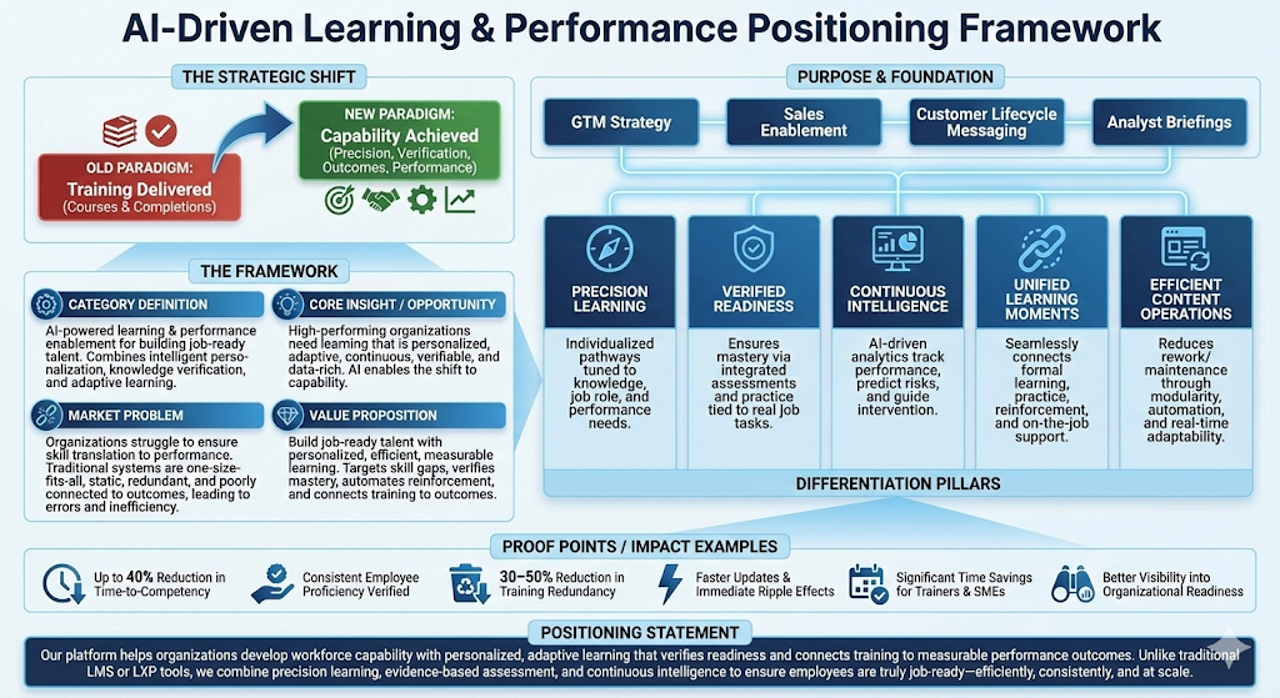
"Build job-ready talent with personalized, efficient, and measurable learning."
Differentiation Pillars
1. Precision Learning
Individualized pathways tuned to specific knowledge gaps, eliminating generic content sequences.
2. Verified Readiness
Ensuring mastery through integrated assessments and practice checks tied to real job tasks.
3. Continuous Intelligence
AI-driven analytics that track performance and predict readiness risks before they impact the business.
4. Unified Experience
Connecting formal learning, reinforcement, and on-the-job support into one seamless workflow.
5. Efficient Operations
Reducing rework and maintenance time through modularity, automation, and real-time adaptability.